 CardMax
Credit Card Statement Date vs Due Date: What Each One Means
Short answer: the statement date is the last day of your billing cycle. On that day your card issuer adds up everything you spent and produces your bill. The due date is the deadline to pay that bill, usually around 21 to 25 days later in the US. Pay the full statement balance by the due date and you normally pay no interest on those purchases.
The statement date sets the bill
Your statement date goes by several names: statement closing date, closing date, billing date or bill date. Whatever your bank calls it, three things happen on that day:
- The billing cycle ends, and purchases after it roll into next month's bill.
- Your statement balance and minimum payment are calculated.
- Many issuers report that balance to the credit bureaus, which is why the balance on your statement date often shapes your credit utilization.
The due date is the deadline
The payment due date is the last day to pay at least the minimum without a late fee. In the US, the CARD Act requires issuers to send your statement at least 21 days before the payment is due, and the due date falls on the same day each month. Other countries use similar gaps, commonly somewhere between two and four weeks.
| Statement date | Due date | |
|---|---|---|
| What it does | Ends the cycle and creates the bill | Deadline to pay the bill |
| Also called | Closing date, bill date | Payment due date |
| Miss it and | Nothing, it just happens | Late fee, possible interest and credit damage |
| Pay before it to | Lower the balance that gets reported | Avoid fees and keep your grace period |
The grace period sits between them
The days between the two dates are your grace period. If you paid last month's bill in full, most cards charge no interest on new purchases as long as you pay this statement balance in full by the due date. Carry a balance past the due date and you usually lose that grace period, so interest starts applying to new purchases straight away until you pay in full again.
What happens if you miss the due date
- A late fee is typically charged the day after the due date.
- Interest applies to the unpaid balance.
- Credit reporting: in the US a payment is generally only reported late once it is 30 or more days past due, but a report at that point can stay on your file for years.
- Penalty rates: some issuers raise your interest rate after a payment is 60 days late.
Which date should you pay on?
Pay the full statement balance any time between the statement date and the due date. If you are working on your credit score, paying part of the balance down before the statement date can lower the balance that gets reported. Either way, the due date is the one date that must never slip.
How to find both dates
Both are printed near the top of every statement, and your bank's app shows them too. Note that the statement date is fixed to a day of the month, while the due date is a set number of days after it, so both stay roughly steady month to month.
How CardMax keeps both dates in front of you
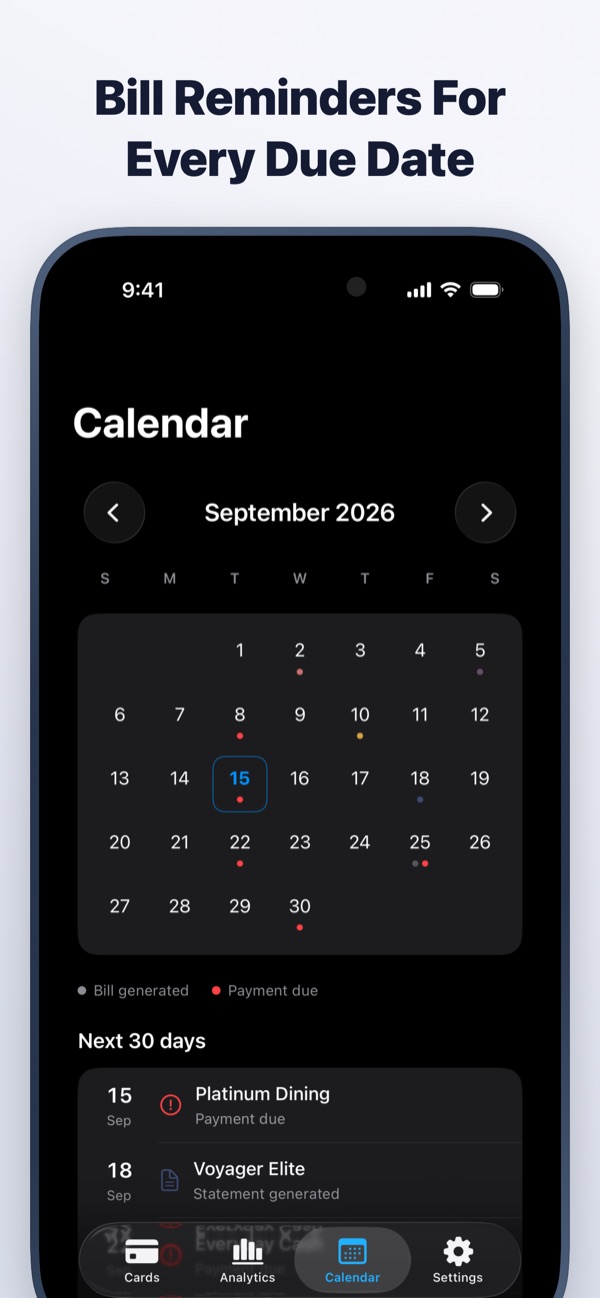
When you add a card to CardMax you enter its bill day and due day once. From then on the app notifies you on the day each statement is generated and again the day before payment is due. If you have already recorded the payment, the reminder tells you so instead of nagging. The Calendar tab shows every card's upcoming dates in one place, and you can sync them to Apple Reminders.
CardMax is coming soon
All your credit cards, bill reminders, statements and spending in one private wallet for iPhone and iPad. Your data never leaves your device.
Coming soon to theApp StoreMore guides
Never miss a due date
A four-part system for tracking every card's due date, even when you juggle several.
Read guideManage multiple cards
Give every card a job, keep the dates in one place, and stop paying for cards you do not use.
Read guideGet your annual fee waived
Hit the spending target, ask at the right moment, or downgrade. Here is how each route works.
Read guide